
₹300 Crore DA, 5,000 Job Opportunities at Stake
The debate has now taken an interesting turn. If ₹300 crore is available annually for the additional DA burden, could a portion of the same financial resources have been used to create new employment opportunities?
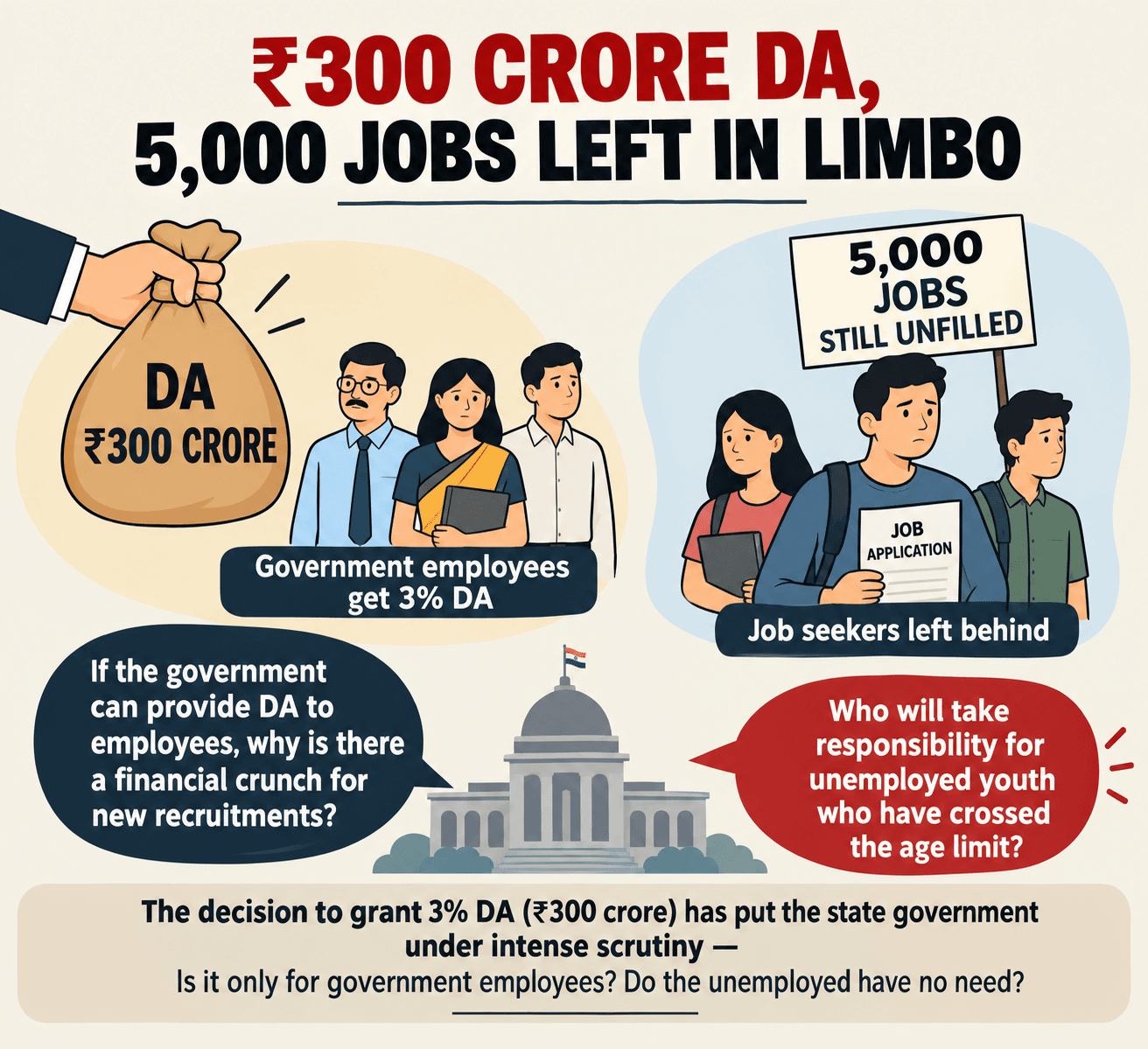
Agartala, October 7: The state government’s decision to grant an additional 3 per cent Dearness Allowance (DA) to government teachers, employees and pensioners with effect from October 1 has brought cheer among employees ahead of the festive season. However, the decision has also raised questions about the government’s priorities and the employment prospects of the state’s large number of unemployed youth.
The additional 3 per cent DA is expected to cost the state exchequer around ₹300 crore annually. During the current financial year, the expenditure from October to March will be around ₹150 crore.
Based on the calculation being discussed, an annual expenditure of ₹300 crore could potentially support government employment for around 10,000 unemployed youths, while ₹30 crore could support employment for around 1,000 people. The comparison has raised questions about whether adequate priority is being given to filling vacant posts and conducting recruitment.
The issue is particularly significant for young people who have been waiting for years for government recruitment opportunities. Many highly qualified candidates continue to wait for job notifications and recruitment examinations, while some risk crossing the upper age limit for government employment.
The government had increased DA for employees and pensioners by 5 per cent in March this year. Within a few months, another 3 per cent increase has been announced. The pace of decisions providing financial benefits to serving employees has therefore become a subject of discussion, while similar urgency is being sought in the recruitment process.
The question being raised is straightforward: if the government can make provision for an additional annual expenditure of ₹300 crore on DA, why cannot a portion of its financial resources be directed towards filling vacant posts, conducting recruitment examinations and launching large-scale employment drives?
The issue goes beyond the immediate financial benefit to employees. For unemployed young people, every delayed recruitment process can have serious consequences. Those who spend years preparing for competitive examinations may eventually cross the prescribed age limit, leaving them with fewer opportunities to enter government service.
Experts argue that ₹300 crore is not merely a financial figure; it also reflects government priorities. If a portion of such resources is directed towards new recruitment, it could potentially open new avenues of income for thousands of families.
The scale of unemployment among young people also remains a concern. According to the Periodic Labour Force Survey (PLFS) 2025, the unemployment rate among people aged 15-29 in the state stood at 11.3 per cent. The figure indicates that the employment challenge is reflected not only in political discourse but also in official data.
The latest DA decision has therefore added another dimension to the debate. On one side are government employees and pensioners receiving additional financial benefits; on the other are thousands of young people waiting for recruitment opportunities.
The contrast has prompted a series of questions. Can the state afford an additional ₹300 crore every year for DA but face financial constraints when it comes to new recruitment? If recruitment is delayed for years, who will take responsibility for candidates who cross the upper age limit while waiting for government jobs?
For government employees, the 3 per cent DA increase has brought welcome relief before the festive season. For unemployed youth, however, the announcement has intensified a different concern: when will the government show similar urgency in creating employment opportunities?
A welfare-oriented government has responsibilities towards both its employees and those seeking employment. Financial benefits for serving employees and measures to generate jobs need not necessarily be viewed as competing priorities. The challenge is to ensure that fiscal resources are managed in a way that addresses both.
The ₹300-crore annual DA burden has consequently opened a wider discussion about employment policy in the state. The question being posed by unemployed youth is not whether government employees deserve financial benefits, but whether job creation deserves equal urgency.
For thousands waiting for recruitment, the issue is particularly pressing. A government job is not simply a salary; for many families, it represents financial security and social stability.
The latest DA decision has therefore placed the government under renewed scrutiny over its employment priorities. The larger question now is whether the state can match the speed with which employee benefits are being extended with an equally determined effort to fill vacant posts and create new employment opportunities.
For the unemployed youth, the demand is simple: if there is financial space for additional expenditure, there should also be a clear roadmap for recruitment.
The debate over the ₹300 crore DA decision is ultimately a debate over priorities—how much the government can spend, where it chooses to spend it, and whether unemployed young people can expect the same urgency when their turn comes.