
Commercial LPG Price Hiked Again Ahead of Festive Season, Adding to Business and Consumer Burden
At a time when the festive season is expected to bring relief and cheer to ordinary households, another round of price escalation has instead added to the financial burden on businesses and consumers. The price of a 19-kg commercial LPG cylinder was increased by another Rs 10 from November 1, taking the revised price in Delhi to Rs 2,820.
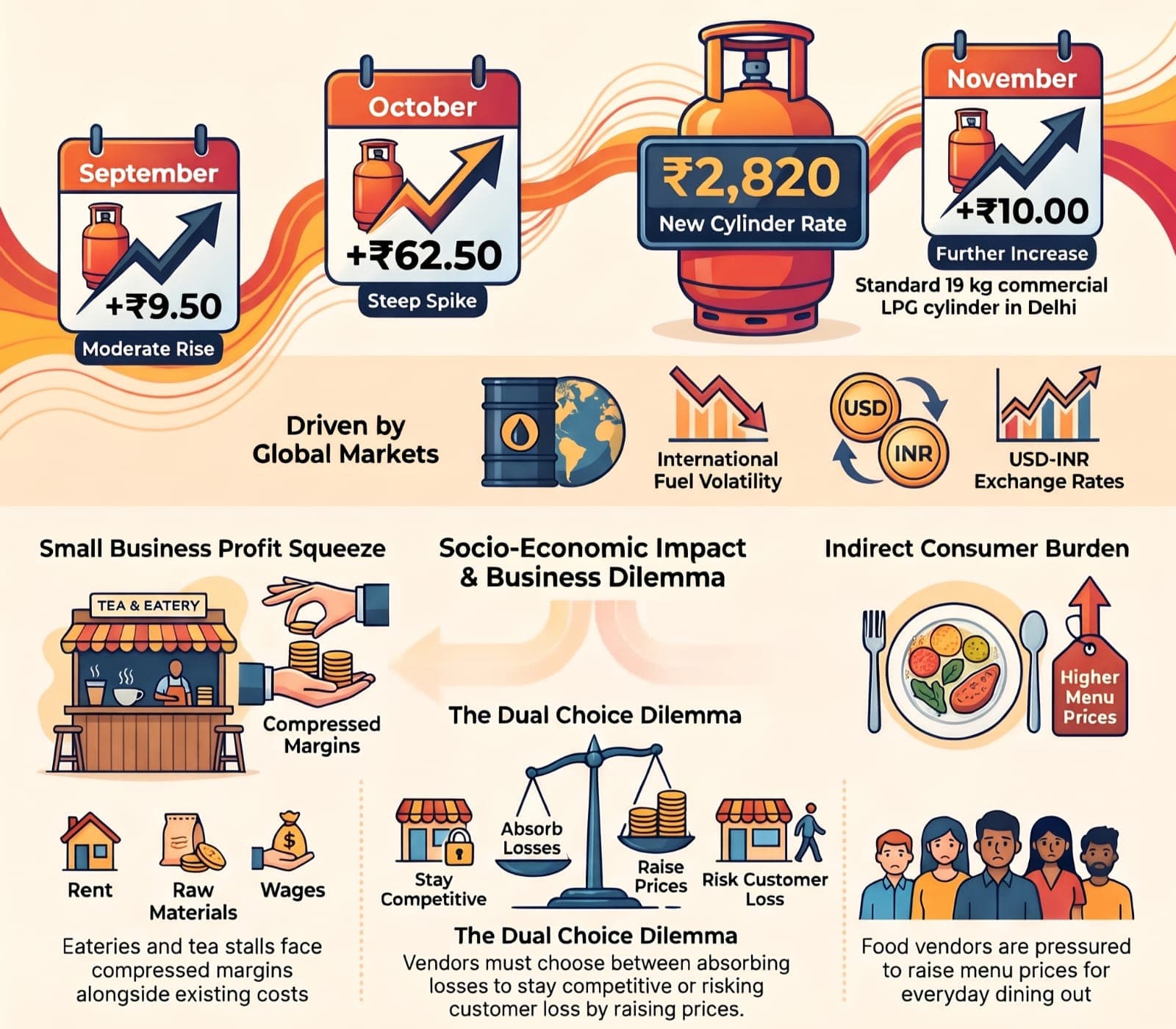
Agartala: At a time when the festive season is expected to bring relief and cheer to ordinary households, another round of price escalation has instead added to the financial burden on businesses and consumers. The price of a 19-kg commercial LPG cylinder was increased by another Rs 10 from November 1, taking the revised price in Delhi to Rs 2,820. Although the latest increase may appear modest in isolation, it comes amid a series of consecutive price hikes and carries wider economic implications.
Commercial LPG prices have now increased for three successive months, with a hike of Rs 9.50 in September, Rs 62.50 in October and another Rs 10 in November. This continuing rise has raised questions about who will take responsibility for the growing pressure on the cost of everyday living, particularly when fluctuations in the international energy market are repeatedly cited as the reason behind domestic price revisions. This is a question the Central Government cannot afford to ignore.
Prices of commercial LPG are revised by state-owned oil marketing companies based on international market rates and the exchange value of the rupee against the US dollar. The Centre may argue that the latest increase reflects fluctuations in the global energy market. However, how far can this explanation absolve the government of its responsibility towards public welfare? Even when international market conditions influence domestic prices, the government has a policy responsibility to consider how the resulting burden on small businesses, hotel owners, restaurant operators and ordinary consumers can be reduced. Merely invoking market forces cannot address the financial difficulties faced by citizens.
The immediate impact is likely to be felt by small hotels, restaurants, roadside eateries, sweet shops, food stalls and tea stalls, many of which depend heavily on commercial LPG for their daily operations. Establishments that consume multiple cylinders every day can face a considerable increase in monthly expenditure even from relatively small price revisions. For businesses operating on narrow profit margins, every additional expense matters. After meeting the costs of raw materials, shop rent, employees' wages and electricity bills, a further increase in cooking gas prices could leave them with even smaller margins.
The consequences may eventually reach the kitchens and pockets of ordinary consumers. If hotel and restaurant owners decide to offset rising operational costs by increasing food prices, customers will bear the additional burden. The cost of breakfast, lunch, evening tea and snacks, as well as eating out, could all come under upward pressure. Although it cannot be assumed that every business will raise its prices, the pressure to absorb higher production costs is undeniable. Thus, even people who do not directly purchase commercial LPG cylinders may end up paying for the increase indirectly.
The issue is particularly significant for a state like Tripura. Small eateries, hotels, restaurants and catering businesses in Agartala and other towns and subdivisions cater to the everyday needs of local residents. With commercial LPG becoming more expensive, business owners are left with two choices: absorb the additional expenditure by reducing their own profit margins or pass the increased costs on to customers through higher food prices. Both options present difficulties. In the first case, the financial stability of small businesses is weakened; in the second, the everyday expenses of ordinary consumers increase. Moreover, intense competition in local markets may prevent all businesses from raising prices uniformly, placing smaller establishments under even greater financial pressure.
It is worth noting that commercial LPG prices have also been increased in September and October this year, before the latest revision in November. The repeated hikes make it necessary for the government to address several questions. Does every increase in international energy prices have to be passed on to small businesses in the domestic market in the same manner? Why should there not be effective policy support to cushion the impact of repeated price increases on businesses and consumers?
Ultimately, one question remains: if every fluctuation in the global energy market eventually translates into a greater burden on small businesses and ordinary consumers, who will take responsibility for protecting their financial interests? The Central Government may cite international market conditions, but it cannot distance itself from the responsibility of managing the impact of price increases on the domestic economy.
An increase of Rs 10 may appear insignificant when calculated against the price of a single cylinder. However, in an environment of repeated price hikes, even such seemingly small amounts can disrupt the financial calculations of thousands of small businesses. What the government needs to provide now is not merely an explanation for rising prices but a practical roadmap to protect the purchasing power of ordinary citizens and the viability of small enterprises.
When cooking gas becomes more expensive, it is not just the price of a cylinder that rises. The cost of food increases, and household budgets come under further strain. How long will ordinary consumers continue to bear the consequences of rising international energy prices? The Central Government must provide an answer.