
Nearly 6,000 Trained Nurses Await Jobs as Tripura Hospitals Face Acute Staff Shortage
According to information available, around 5,500 to 6,000 unemployed youths who have completed various nursing courses are currently awaiting employment in the state. At the same time, a significant number of serving nurses are retiring with age, further widening the vacancies.
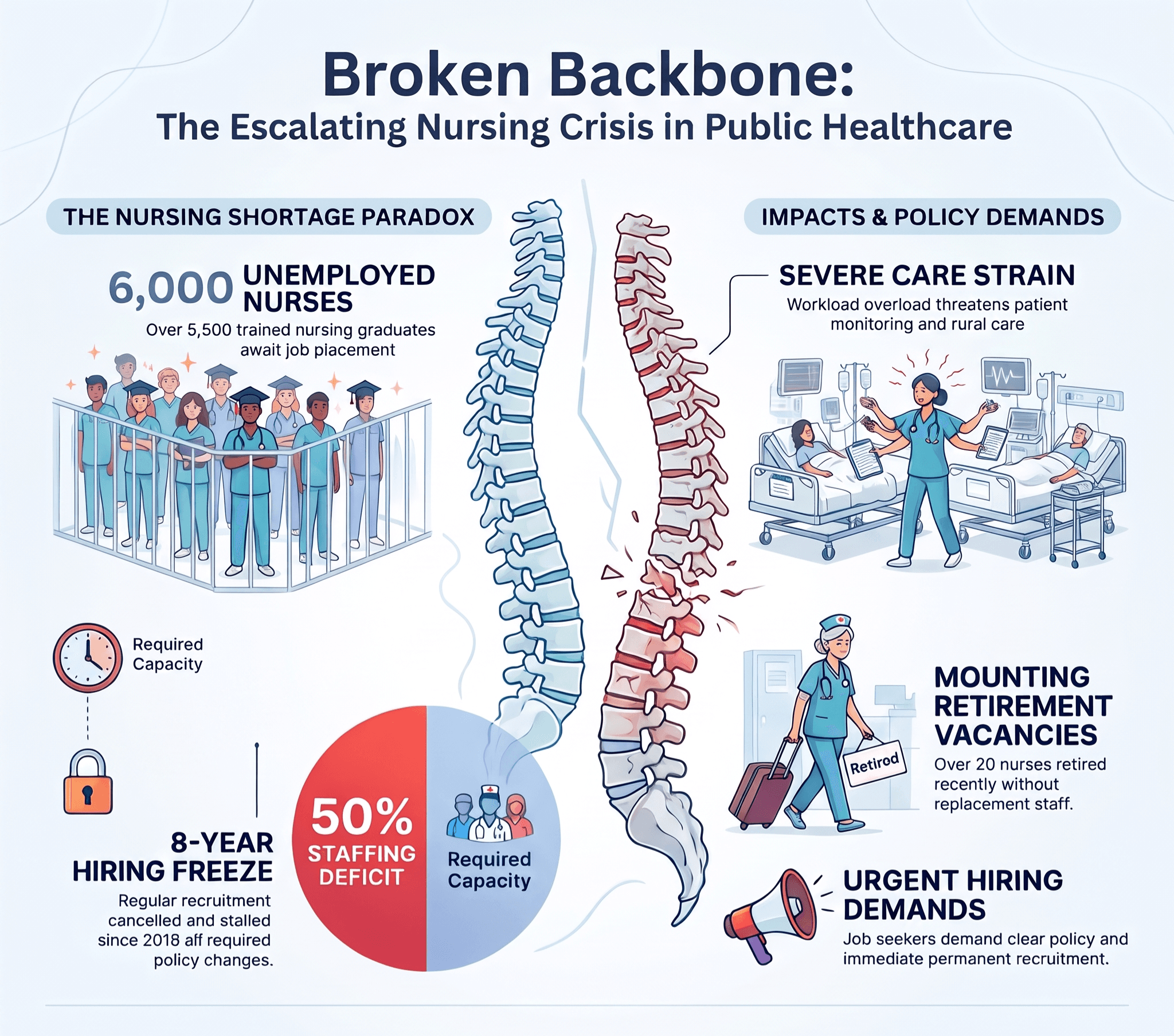
Agartala: Tripura's public healthcare system is facing a growing contradiction: government hospitals are struggling with a severe shortage of nursing staff, while nearly 5,500 to 6,000 trained nursing graduates remain unemployed and wait for recruitment opportunities. Despite rising patient numbers and repeated promises to expand healthcare infrastructure, the shortage of nurses is increasingly affecting the delivery of essential medical services.
Allegations suggest that regular recruitment of nurses in the state has remained virtually stalled for the past seven to eight years. The shortage is reportedly acute even at Agartala Government Medical College and GBP Hospital, the state's principal referral hospital in the capital. According to complaints, the number of nursing personnel available is barely half of what is required in proportion to the patient load.
Doctors may be responsible for diagnosis and treatment, but nurses play an equally critical role in providing round-the-clock patient care, administering medicines, monitoring health conditions and responding to emergencies. When an inadequate number of nurses must handle an excessive number of patients, the pressure inevitably affects the quality and efficiency of hospital services.
The recruitment history raises further questions. In 2016, the Health Department initiated a recruitment process for around 787 nursing posts. However, the process had not been completed even by December 2017. After the new government assumed office in 2018, it announced plans to introduce a fresh recruitment policy. Subsequently, the ongoing recruitment process for nursing personnel, along with several other recruitment exercises, was cancelled.
Since then, regular direct recruitment has remained a prolonged uncertainty. What happened to the recruitment process initiated in 2016? Why was it not completed? And if a new recruitment policy was introduced, why has it failed to produce visible results in filling nursing vacancies?
During the COVID-19 pandemic, some nurses were recruited through the National Health Mission on an 11-month contractual basis. They were reportedly assured that regular recruitment arrangements would be made once the pandemic situation improved. However, questions remain over the fulfilment of that assurance. Contractual employees continue to face uncertainty over job security, with no clear guarantee of regularisation.
The result is a two-sided crisis: hospitals are struggling with a shortage of permanent nursing staff, while those recruited on contract remain uncertain about their professional future, despite having served during an exceptionally difficult period for the healthcare system.
The availability of trained manpower is not the problem. According to information available, around 5,500 to 6,000 unemployed youths who have completed various nursing courses are currently awaiting employment in the state. At the same time, a significant number of serving nurses are retiring with age, further widening the vacancies.
GBP Hospital alone has reportedly seen around 20 to 25 nurses retire in the past six months. Unless these vacancies are filled promptly, hospitals could face even greater difficulties in maintaining regular services.
The shortage is not confined to major hospitals in the capital. District hospitals, subdivision hospitals and various health centres are also reportedly facing a shortage of nursing personnel. In several places, doctors may be available, but the absence of adequate nursing staff creates difficulties in patient care, maternity services, emergency treatment and routine healthcare delivery.
The problem is particularly serious in rural and remote areas, where people depend heavily on local health centres for basic medical assistance. Without sufficient nursing personnel, the government's objective of taking healthcare services closer to people's doorsteps remains difficult to achieve.
Meanwhile, unemployed nursing graduates have stepped up their protests demanding recruitment. Job aspirants recently demonstrated outside the Directorate of Health Services, seeking regular appointments to the posts of Staff Nurse, Auxiliary Nurse Midwife (ANM) and APW. They have argued that after years of education and professional training, they continue to face an uncertain future without employment opportunities.
For many families, nursing education was an investment made with the expectation of a stable career, particularly in government healthcare institutions. That expectation is increasingly turning into disappointment.
The government's policy approach has therefore come under scrutiny. Nursing courses continue to be offered through government-supported institutions every year, with students investing considerable time, money and effort in acquiring professional qualifications. Yet, the question remains: what employment prospects await them after completing their training?
If the government does not have a concrete plan to recruit the nursing personnel required by its own healthcare system, the continued expansion of nursing education risks adding to the pool of unemployed trained candidates. A long-term strategy linking nursing education, projected vacancies and recruitment requirements is clearly necessary.
Although recruitment decisions for several departments have figured in various state Cabinet meetings, the absence of any visible decision on appointments to Nursing Officer posts under the Health Department has added to the frustration of job aspirants.
Healthcare is not a luxury; it is a basic public necessity. The immediate requirements include recruitment against existing vacancies, publication of hospital-wise vacancy figures, filling posts left vacant through retirement, a clear policy on the future of contractual employees and a definite timeline for regular recruitment.
Expanding hospital buildings, installing new medical equipment and publicising infrastructure projects cannot, by themselves, establish the success of a healthcare system. Its real strength is measured by whether a trained nurse is available beside a patient when care is needed most.
Nearly 6,000 trained but unemployed nursing candidates on one side and hospitals struggling to provide services because of staff shortages on the other represent a serious administrative contradiction. The government must explain what is holding up recruitment and when the crisis will be addressed.