
Pradyot Debbarman Quits Active Politics Again, Leaving Tipra Motha's Unfinished Promises Behind
"This is not a temporary withdrawal or a decision made in anger," Pradyot said. "It is a deeply personal choice, taken after years of service and reflection." The letter was issued under the name Pradyot Bikram Manikya, while the signature at the end carries the name Pradyot.
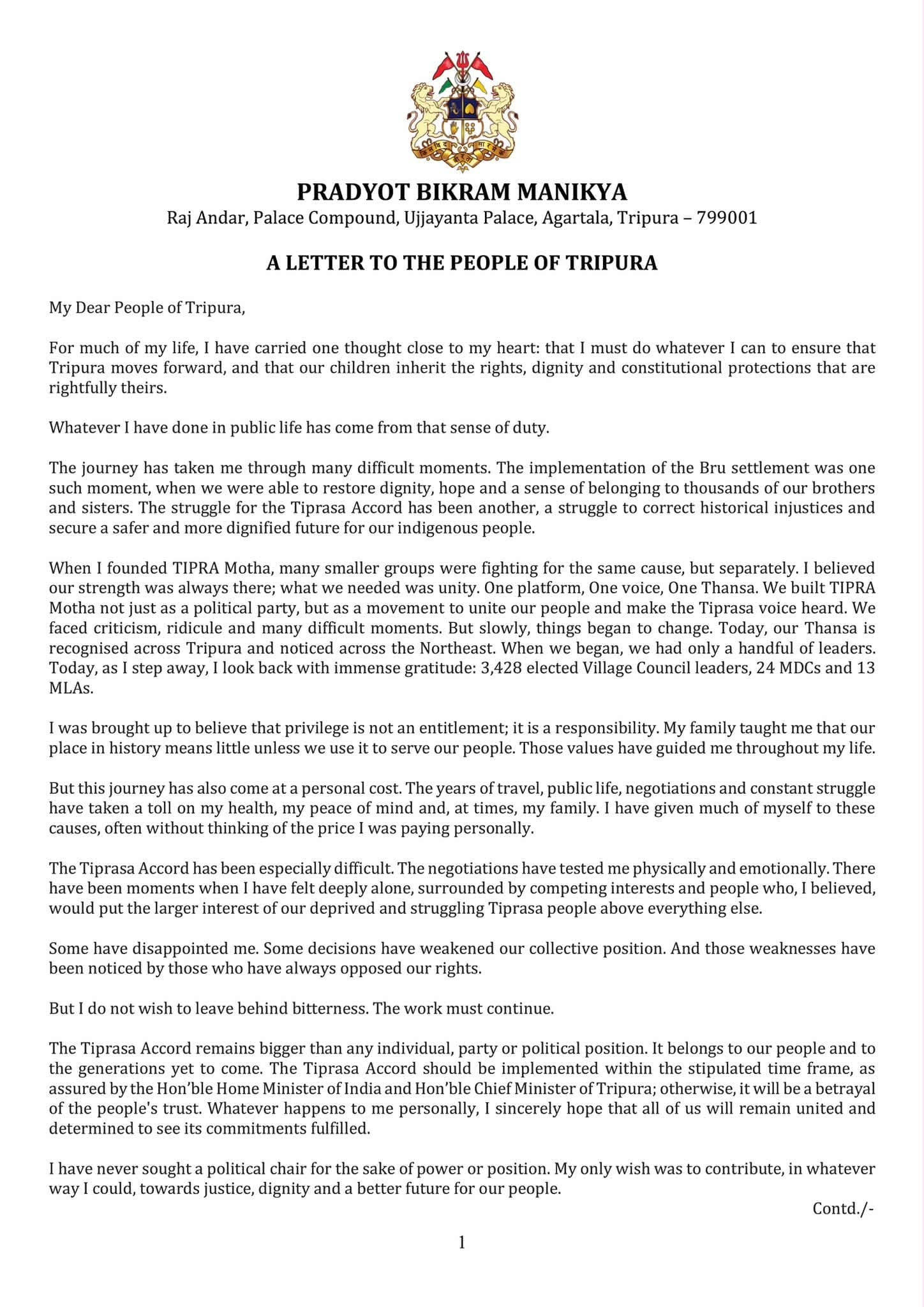
AGARTALA: Pradyot Debbarman, the founder of Tipra Motha, announced that he was stepping away from active politics--for the second time in three years---, closing another chapter of a political journey built on promises of rights, the Tiprasa Accord and the promise of a larger political settlement for Tripura's tribal population. Practically, it has been his third 'goodbye' to the politics. After resigning from the Congress state presidency with wounds of humiliating defeat in the 2019 Lok Sabha elections for which he provided his sister a candidature, he said that he was away from politics. As the ADC elections were announced in 2021, overnight he formed a political party. In an open letter addressed to the 'people of Tripura' on Tuesday, Pradyot Debbarman said his decision was final and was not a temporary withdrawal or a decision taken in anger. "Today, after much thought and considerable pain, I am making a clear and final decision: I am stepping away from active politics," he wrote. He said he would no longer hold a political office or participate in day-to-day political activity, citing his health, family and the need to recover from years of public life. "This is not a temporary withdrawal or a decision made in anger," Pradyot said. "It is a deeply personal choice, taken after years of service and reflection." The letter was issued under the name Pradyot Bikram Manikya, while the signature at the end carries the name Pradyot. His name, in different forms, is available in records, including Pradyot Debbarma, Pradyot Debbarman, etc.
The decision came after a political career in which he drew the emotion of people with the demand of a separate state for the ST population. Pradyot said in the letter that when he founded TIPRA Motha, several smaller organisations were pursuing similar causes separately. His objective, he said, was to bring them together under one platform and one political voice. "We built TIPRA Motha not just as a political party, but as a movement to unite our people and make the Tiprasa voice heard," he wrote. He recalled the movement's progression from a relatively small political force to an organisation with elected representatives across Tripura. He cited 3,428 elected Village Committee leaders, 24 members of the Tripura Tribal Areas Autonomous District Council and 13 MLAs as evidence of how far the movement had travelled. But the letter also claimed a personal cost of that journey. Pradyot wrote that years of travel, public life, negotiations and political struggle had taken a toll on his health, peace of mind and family life.
The Tiprasa Accord, he claimed, had been particularly difficult. Negotiations had left him physically and emotionally exhausted and, at times, deeply isolated. Yet he said he did not want to leave politics with bitterness. "The work must continue," he wrote. He also insisted that the Tiprasa Accord was larger than any individual or political party. "The Tiprasa Accord remains bigger than any individual, party or political position," Pradyot said, adding that it belonged to the people and future generations. He said the agreement should be implemented within the stipulated timeframe assured by the Union Home Minister and the Tripura chief minister, warning that failure to do so would amount to a betrayal of the people's trust. The accord that remains unfinished. That pledge now stands against one of the central unresolved issues of Pradyot Debbarman's political legacy.
The Tiprasa Accord was signed in March 2024 after negotiations involving the Centre, the Tripura government and representatives associated with Tipra Motha. It was presented as a framework to address the political, constitutional, economic and social concerns of the indigenous population. More than two years later, its implementation remains incomplete. The accord was expected to move towards implementation within six months. Instead, the process stretched well beyond that deadline. More recently, there were indications that work on implementing the accord would begin, with visible signs of movement not even emerging. The delay has already turned implementation into one of the defining questions surrounding Tipra Motha and its founder. A larger problem is that several of the terms used during the political campaign that brought Pradyot and Tipra Motha to prominence were never translated into a detailed, publicly defined settlement. "Greater Tipraland" was one of the principal political promises and principles associated with the movement. The larger constitutional or written assurance repeatedly invoked by Pradyot and his supporters was also never clearly defined in the form in which many supporters expected it to materialise. The result is a widening gap between the political expectations created by the movement and what has so far become materially visible on the ground.
From opposition movement to government partner
Tipra Motha's political position changed substantially after it entered an alliance with the BJP. The party moved from being a major challenger to the established political order to becoming a partner of the BJP-led government, with Tipra Motha leaders receiving ministerial positions in the state cabinet. Pradyot's sister managed an MP seat by this understanding. That alliance gave the party direct access to government and executive power in state governance. But it also created a new test for Pradyot's politics: whether participation in government could produce visible changes in the lives of the tribal population whose interests the party had built its political identity around. So far, critics can point to the absence of a visible transformation. The political argument that had once been made from outside government - that constitutional protection, political rights and development required a new settlement - became a test of what Tipra Motha could deliver from within government. For many supporters, the question is no longer simply whether the party can articulate grievances. It is whether its participation in power has produced tangible results. Power in the ADC, but old questions remain. Tipra Motha is also in its second consecutive term in control of the Tripura Tribal Areas Autonomous District Council. Yet the ADC itself has remained caught in serious administrative and legal controversies. Among them is the dispute over pension benefits for retired employees, which has reached the courts. The council has also faced allegations of illegal recruitment. The latter issue is particularly significant because transparency and clean recruitment were among the promises associated with Pradyot's political rise. Pradyot had promised greater transparency and had said that alleged illegal recruitments would be cancelled. Those promises, however, have not translated into the sweeping corrective action that supporters had been led to expect. Instead, questions over recruitment and the treatment of retired employees remain part of the ADC's unresolved record. This leaves Tipra Motha facing an uncomfortable contrast: the movement has accumulated electoral power, administrative control and representation in the state government, but many of the issues that originally fuelled its rise remain unsettled. 'I do not know what the future holds' Pradyot's letter did not suggest that he was abandoning Tripura or the causes that defined his politics. He explicitly distinguished leaving active politics from leaving the state. "I will always remain connected to our people and committed to their dignity, rights and future," he wrote. He said he would remain available whenever his experience, advice or assistance could be of service and would continue to stand for the dignity of indigenous communities and a peaceful and prosperous Tripura. He also acknowledged mistakes and disappointments during his political career. "I have made mistakes. I have faced disappointments," he wrote. "But through it all, I have never stopped believing in Tripura." For now, he said, he wanted a quieter chapter of his life, closer to his family and to the things he had left unfinished. "I do not know what the future holds," he wrote. "But I know this: wherever life takes me, Tripura will always remain in my heart." His departure therefore came at a politically consequential moment. Tipra Motha moved from a movement demanding a fundamental political settlement to a party sharing power with the BJP, while the settlement at the centre of its politics remained unfinished. Pradyot Debbarman left active politics, saying that the work must continue. What remained to be seen is whether the political project he built can now move forward without the man who made it his central political identity.