
Two-Day National Seminar on ‘Literature and Science: Contemporary Perspectives’ Begins at I.C. Vidyasagar College
A two-day national seminar on the theme “Literature and Science: Contemporary Perspectives” was organised at Ishwar Chandra Vidyasagar College on November 2 and 3, 2026, through the joint initiative of the college's Department of Bengali, Internal Quality Assurance Cell (IQAC) and Research Development Cell (RDC), in collaboration with the Bharat Gyan Vigyan Samiti, Tripura.
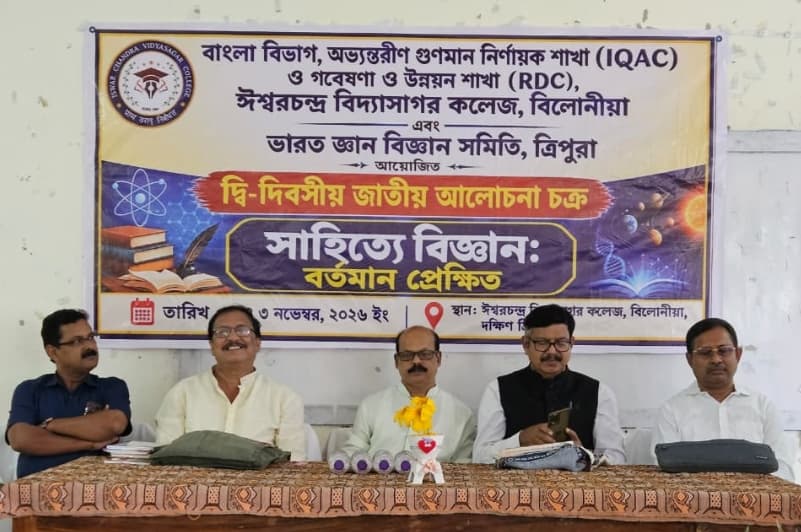
Agartala: A two-day national seminar on the theme “Literature and Science: Contemporary Perspectives” was organised at Ishwar Chandra Vidyasagar College on November 2 and 3, 2026, through the joint initiative of the college's Department of Bengali, Internal Quality Assurance Cell (IQAC) and Research Development Cell (RDC), in collaboration with the Bharat Gyan Vigyan Samiti, Tripura.
The programme began with the rendition of Vande Mataram and the National Anthem, creating a solemn and patriotic atmosphere. Novelist Dilip Roy formally inaugurated the seminar. In his inaugural address, he highlighted the reflection of scientific temperament in literary creativity, observing that literature is not merely an expression of imagination but also a reflection of life and social realities. He noted that a scientific outlook enriches literary thought and creativity.
Chief Guest Sushanta Ghosh, adviser to Panchaban Gharana Sahitya, emphasised the complementary roles of literature and science in society. He said that while literature awakens human values, science promotes rational thinking. Both are essential for building a progressive society free from superstition.
Writer and researcher Amalesh Ghosh, the keynote speaker, stressed the need to explore whether literature itself could be understood as a form of science. He pointed out that although literature and science follow different methodologies, both ultimately seek the truth through observation, analysis, inquiry and research.
Special Speaker Professor Utpal Chandra Dey, Joint Secretary of Bharat Gyan Vigyan Samiti, discussed the pioneering role of literature in shaping scientific imagination and inspiring future discoveries. Referring to examples of science fiction and scientific developments, he explained the importance of the seminar to students. Summing up his central philosophy, he remarked, “Literature comes first, science follows; literature belongs to the mind, while science belongs to the intellect.” He observed that literature generates dreams and imagination, while science transforms those dreams into reality through research.
RDC Coordinator Dr Rahul Bhattacharya highlighted new research opportunities emerging from the intersection of literature and science, particularly in areas such as artificial intelligence, the environment, technology and the transformation of human civilisation.
IQAC Coordinator Dr Ashish Kumar Roy stressed the importance of integrating literary and scientific studies to improve the quality of higher education. He said such an interdisciplinary approach could foster creativity, human values, rational thinking and a research-oriented mindset among students.
Resource person Professor Malakar described literature and science as twin disciplines that complement each other, observing that literature searches for truth while science gives it practical completeness.
Presiding over the seminar, College Principal Dr Manoranajan Das spoke about the combined contribution of literature and science to the progress of human civilisation. He said science makes human life dynamic, while literature gives it a humane dimension. Emphasising the rationalist and humanist ideals of Ishwar Chandra Vidyasagar, he called for greater integration of literary and scientific pursuits in education.
“The central message of this seminar is that literature teaches humanity to dream, while science teaches it how to turn those dreams into reality. Literature represents the intellectual consciousness of civilisation, while science represents its intellect. Their convergence gives completeness to human civilisation,” he observed.
Dr Das further expressed hope that the national seminar would open new avenues of thought regarding the relationship between literature and science, their relevance in contemporary society, and emerging opportunities in research and education.
Professors, researchers and students from various colleges participated in the seminar and presented their research papers, making the event a platform for academic exchange and interdisciplinary discussion.
Organising Secretary Professor Souvik Bakshi expressed gratitude to colleagues, students and all those who extended direct and indirect support in organising the seminar, including speakers from Tripura and other states. Convenor Dr Rajib Lal Debbarma welcomed the distinguished guests, speakers and participants, expressing confidence that their discussions and exchange of ideas would enrich intellectual understanding and open new horizons of thought.
The seminar concluded with an appeal for active participation and continued academic collaboration to strengthen the dialogue between literature and science.